

Datasheet4U Logo Datasheet4U.com

MAX17620 - Synchronous Step-Down DC-DC Converter

Datasheet Summary

Description

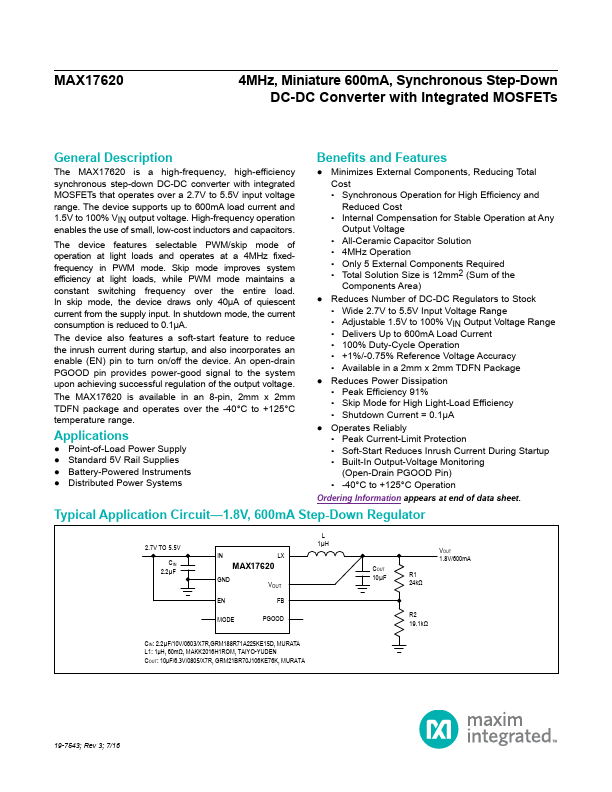
The MAX17620 is a high-frequency, high-efficiency synchronous step-down DC-DC converter with integrated MOSFETs that operates over a 2.7V to 5.5V input voltage range.

The device supports up to 600mA load current and 1.5V to 100% VIN output voltage.
Features

  • selectable PWM/skip mode of operation at light loads and operates at a 4MHz fixedfrequency in PWM mode. Skip mode improves system efficiency at light loads, while PWM mode maintains a constant switching frequency over the entire load. In skip mode, the device draws only 40µA of quiescent current from the supply input. In shutdown mode, the current consumption is reduced to 0.1µA. The device also features a soft-start feature to reduce the inrush current during startup, and also incorporates an e.

📥 Download Datasheet

Datasheet preview – MAX17620

Datasheet Details

Part number MAX17620
Manufacturer Maxim Integrated
File Size 820.15 KB
Description Synchronous Step-Down DC-DC Converter
Datasheet download datasheet MAX17620 Datasheet
Additional preview pages of the MAX17620 datasheet.
Other Datasheets by Maxim Integrated

Full PDF Text Transcription

Click to expand full text
MAX17620 4MHz, Miniature 600mA, Synchronous Step-Down DC-DC Converter with Integrated MOSFETs General Description The MAX17620 is a high-frequency, high-efficiency synchronous step-down DC-DC converter with integrated MOSFETs that operates over a 2.7V to 5.5V input voltage range. The device supports up to 600mA load current and 1.5V to 100% VIN output voltage. High-frequency operation enables the use of small, low-cost inductors and capacitors. The device features selectable PWM/skip mode of operation at light loads and operates at a 4MHz fixedfrequency in PWM mode. Skip mode improves system efficiency at light loads, while PWM mode maintains a constant switching frequency over the entire load. In skip mode, the device draws only 40µA of quiescent current from the supply input.
Published: |